![Green Lab. #08 [ A Stone Assembly Alive with Moss ]](https://www.adana.co.jp/wp-content/uploads/sites/3/2026/01/gl08_img_ogp.jpg)
![Green Lab. #07 [ Forest Suspension Bridge]](https://www.adana.co.jp/wp-content/uploads/sites/3/2026/01/gl07_img_ogp.jpg)






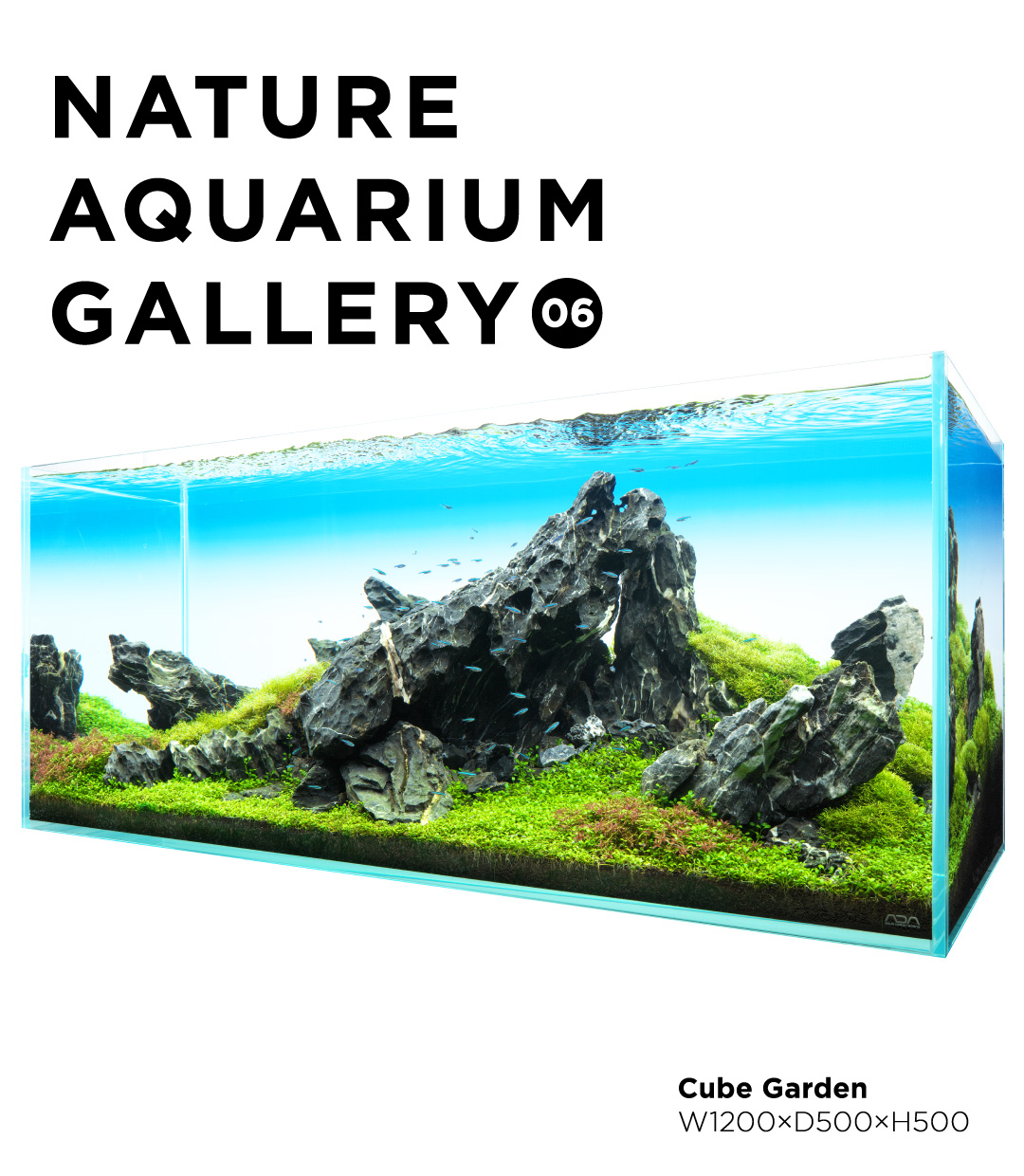
NATURE AQUARIUM GALLERY #06 “Great Wave Rock”

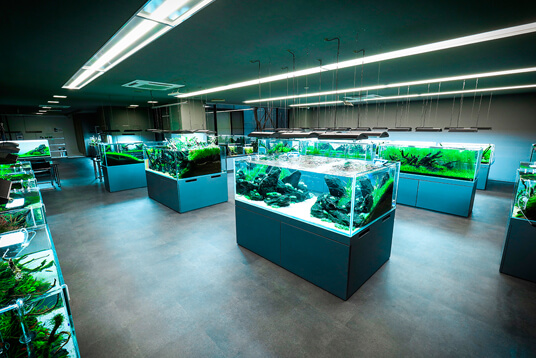
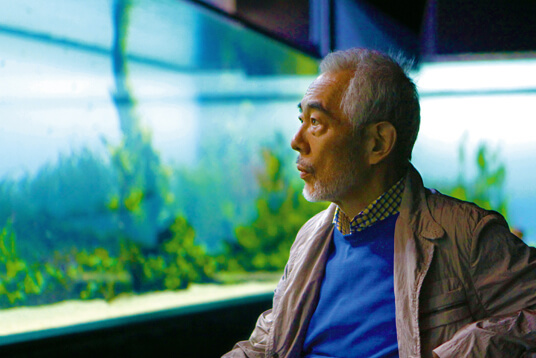
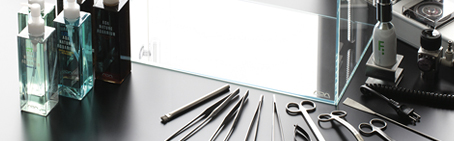
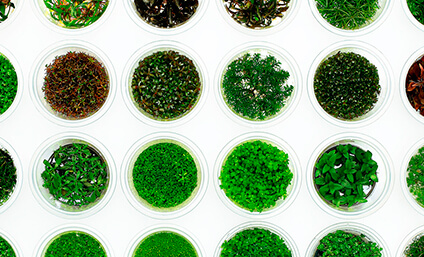
At the Nature Aquarium Gallery, aquascapes are created and maintained every day. Through this ongoing work, ADA has developed a deep and practical knowledge of Nature Aquarium. In the web series NATURE AQUARIUM GALLERY, we interview ADA SUIKEI Creators and ADA’s expert maintenance staff to explore their creations and share tips on how to care for and grow aquatic environments using ADA products.
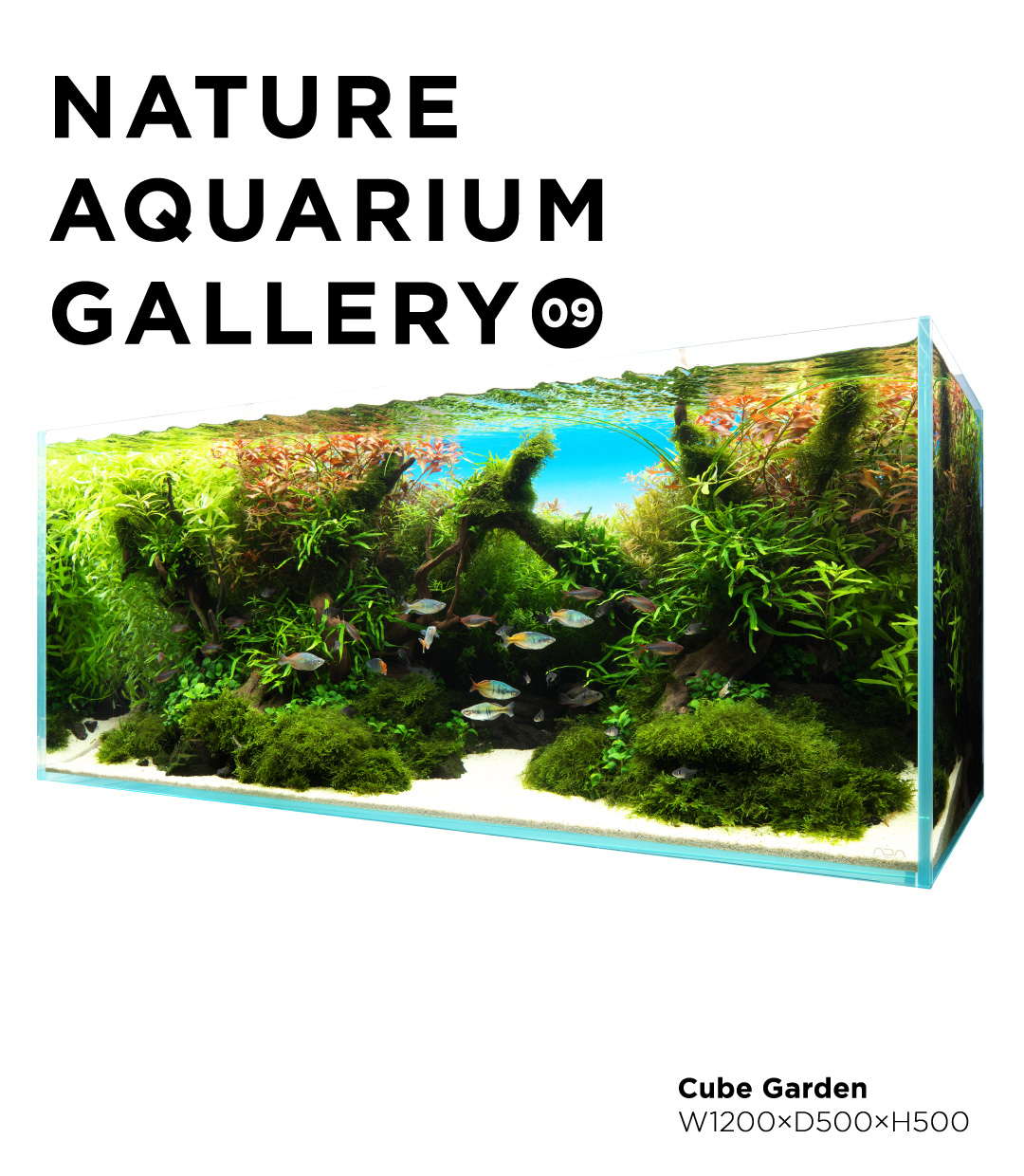
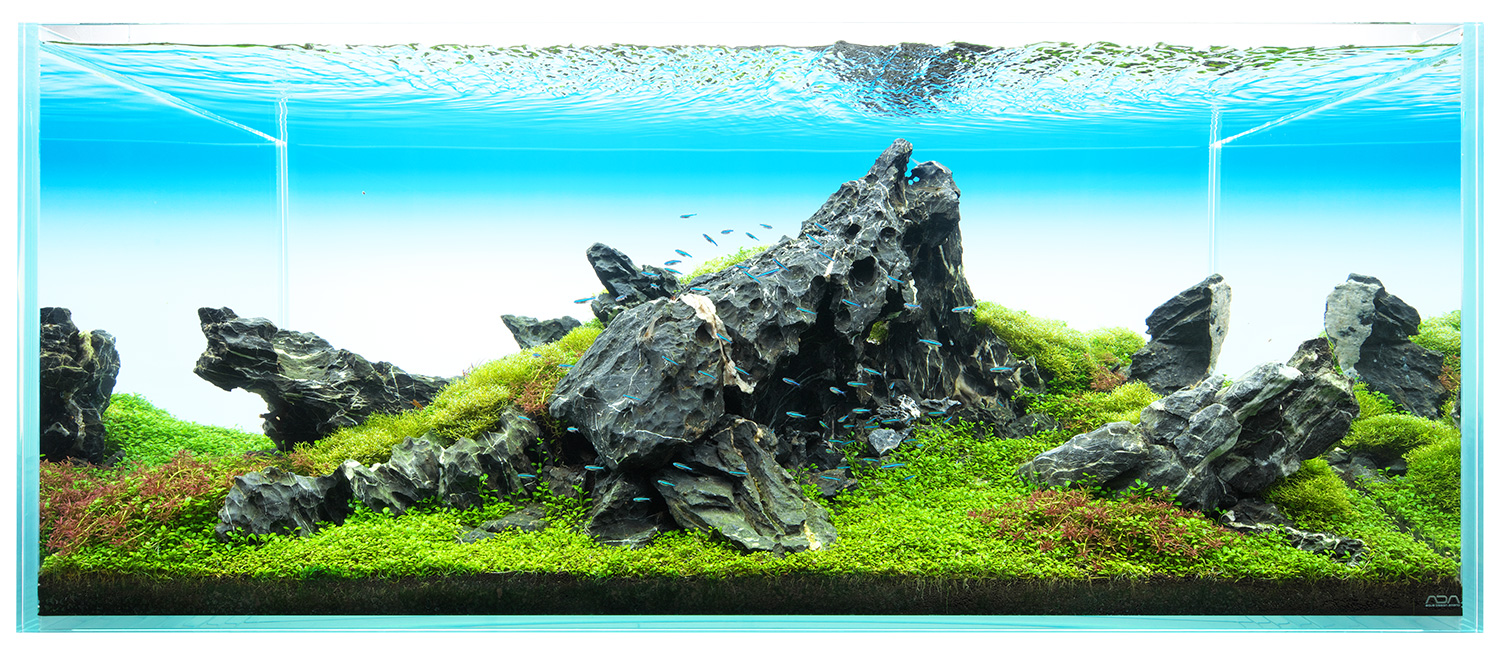
The wave-like forms expressed through stone bring a sense of dynamism to the aquascape.
[ Great Wave Rock ]
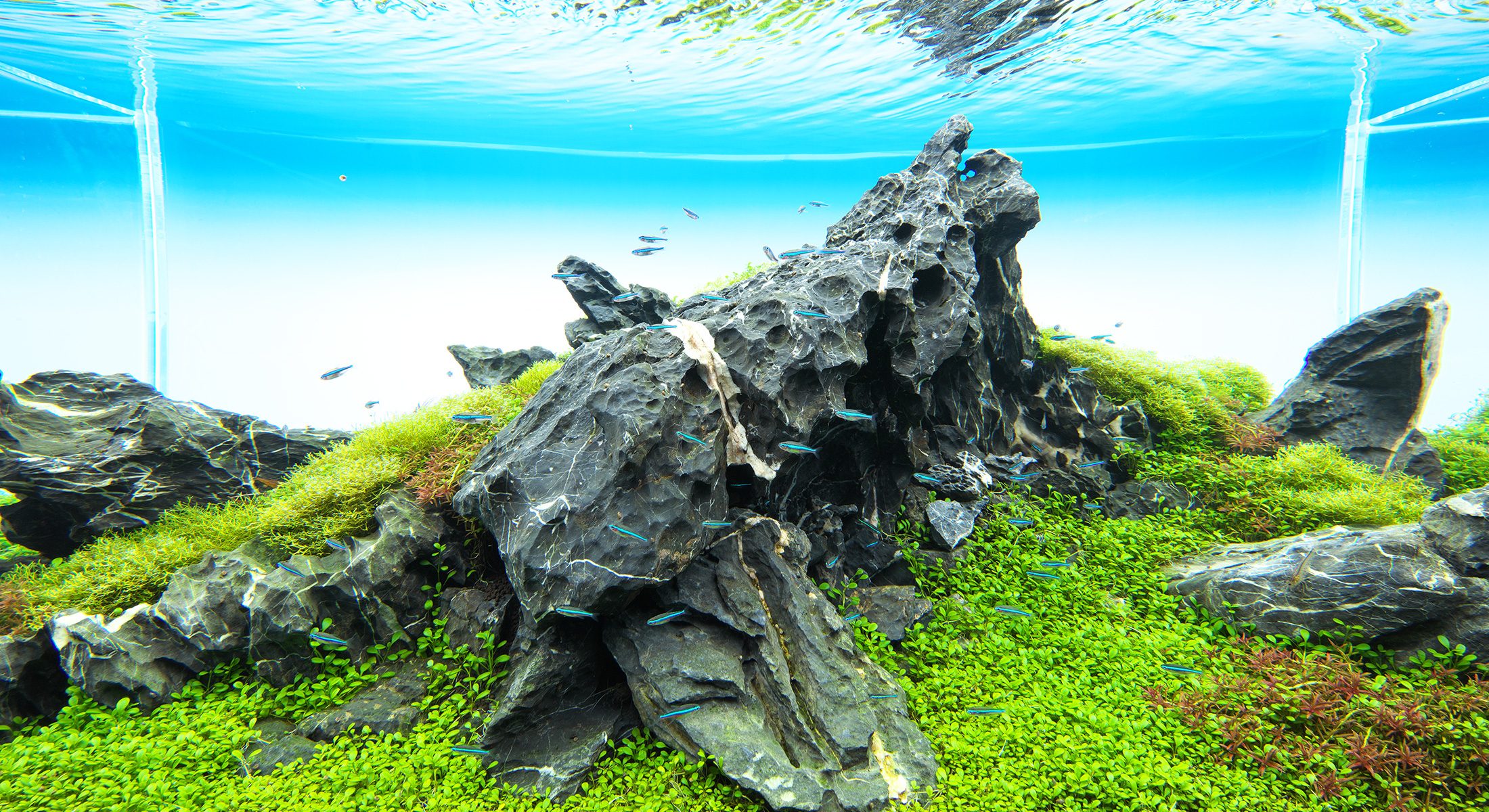
A main stone was placed at the center of the aquarium, and a bold arrangement of surrounding stones was composed to form a wave-like shape. The motif of stones radiating from the main stone creates a chain reaction that expands throughout the layout, resulting in a lively, convex composition—like a single large wave spreading outward into a series of smaller waves.
A main stone was placed at the center of the aquarium, and a bold arrangement of surrounding stones was composed to form a wave-like shape. The motif of stones radiating from the main stone creates a chain reaction that expands throughout the layout, resulting in a lively, convex composition—like a single large wave spreading outward into a series of smaller waves.
DATA
Creation date: October 3, 2024
Photo taken on: December 26, 2024
Creator: Naru Uchida(ADA SUIKEI CREATOR)
Aquarium: Cube Garden W1,200×D500×H500(mm)
Lighting: Solar RGB x 2 (8.5 hours per day)
Filtration: Super Jet Filter ES-1200 (Bio Rio G)
Material: Ryuoh Stone
Substrate: Aqua Soil – Amazonia Ver.2, Power Sand Advance L, Bacter 100, Clear Super, Tourmaline BC
CO2: Pollen Glass Beetle 40Ø, 5 bubbles per second via CO2 Twist Counter (using Tower)
Aeration: 15.5 hours after the light is turned off using Lily Pipe P-6
Additives: Brighty K, Green Brighty Mineral, Green Brighty Iron, Green Brighty Nitrogen, Soft Water
Water change: 1/3 once a week
Water quality: Temperature 25°C, pH: 6.4, TH: 50 mg/L
Plants
Glossostigma elatinoides
Riccia fluitans
Rotala mexicana ‘Goias’
Fish
Paracheirodon simulans
Crossocheilus oblongus
Otocinclus sp.
Caridina multidentata
Creation date: October 3, 2024
Photo taken on: December 26, 2024
Creator: Naru Uchida(ADA SUIKEI CREATOR)
Aquarium: Cube Garden W1,200×D500×H500(mm)
Lighting: Solar RGB x 2 (8.5 hours per day)
Filtration: Super Jet Filter ES-1200 (Bio Rio G)
Material: Ryuoh Stone
Substrate: Aqua Soil – Amazonia Ver.2, Power Sand Advance L, Bacter 100, Clear Super, Tourmaline BC
CO2: Pollen Glass Beetle 40Ø, 5 bubbles per second via CO2 Twist Counter (using Tower)
Aeration: 15.5 hours after the light is turned off using Lily Pipe P-6
Additives: Brighty K, Green Brighty Mineral, Green Brighty Iron, Green Brighty Nitrogen, Soft Water
Water change: 1/3 once a week
Water quality: Temperature 25°C, pH: 6.4, TH: 50 mg/L
Plants
Glossostigma elatinoides
Riccia fluitans
Rotala mexicana ‘Goias’
Fish
Paracheirodon simulans
Crossocheilus oblongus
Otocinclus sp.
Caridina multidentata
Planting & Maintenance Tips
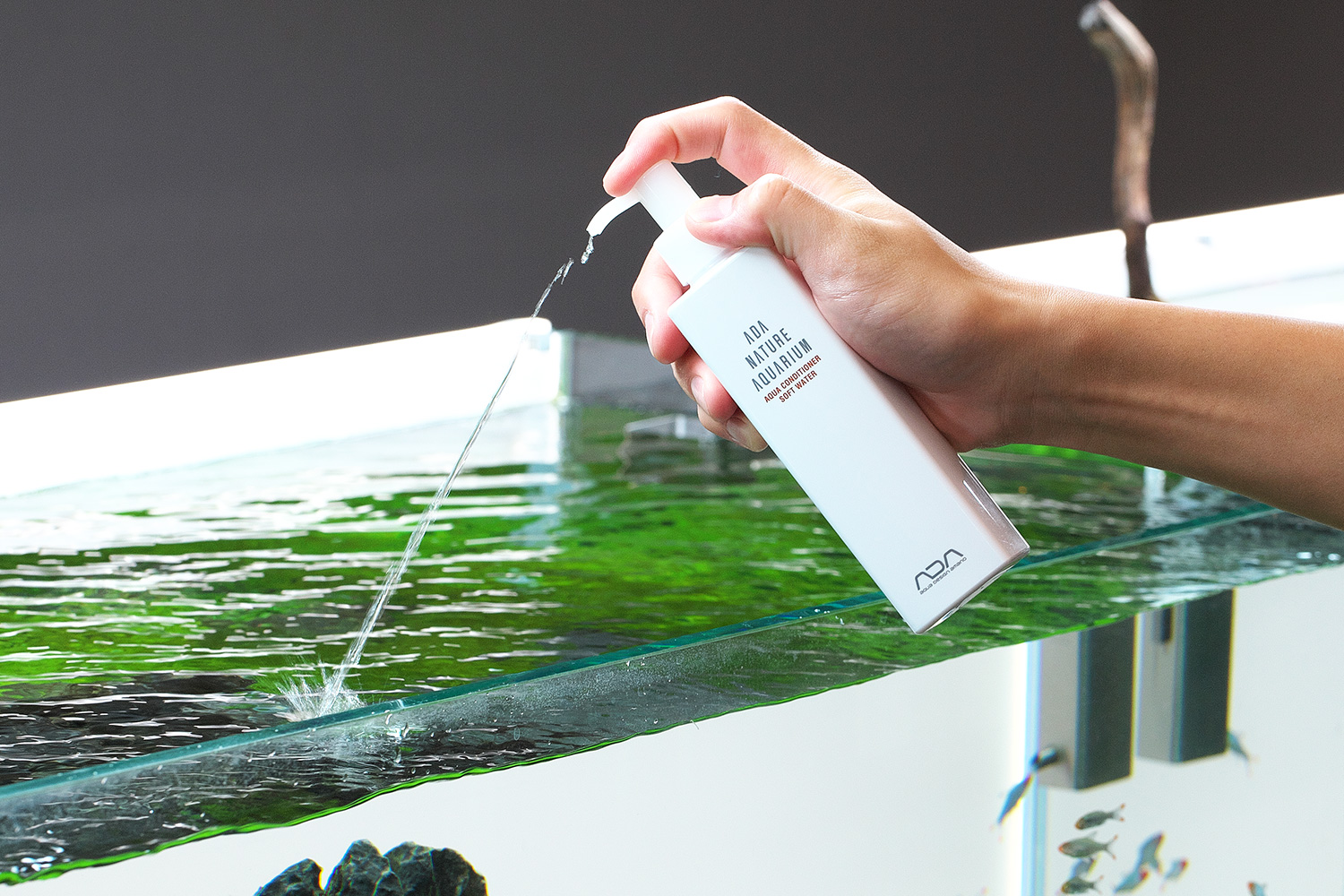
Use soft water to balance the pH
Glossostigma elatinoides and Rotala mexicana ‘Goias’ are hardy aquatic plants that maintain their vivid coloration even in slightly higher pH environments. However, Riccia can suffer if the water becomes too alkaline—its leaves harden and it stops producing the fine oxygen bubbles that appear during photosynthesis.
By adjusting with soft water to keep the pH around 6.4, Riccia will resume vigorous photosynthesis and once again produce delicate, beautiful oxygen bubbles.
Since some aquariums have strong buffering capacity and resist pH changes, measure levels carefully with a pH test kit and make adjustments gradually.
Glossostigma elatinoides and Rotala mexicana ‘Goias’ are hardy aquatic plants that maintain their vivid coloration even in slightly higher pH environments. However, Riccia can suffer if the water becomes too alkaline—its leaves harden and it stops producing the fine oxygen bubbles that appear during photosynthesis.
By adjusting with soft water to keep the pH around 6.4, Riccia will resume vigorous photosynthesis and once again produce delicate, beautiful oxygen bubbles.
Since some aquariums have strong buffering capacity and resist pH changes, measure levels carefully with a pH test kit and make adjustments gradually.
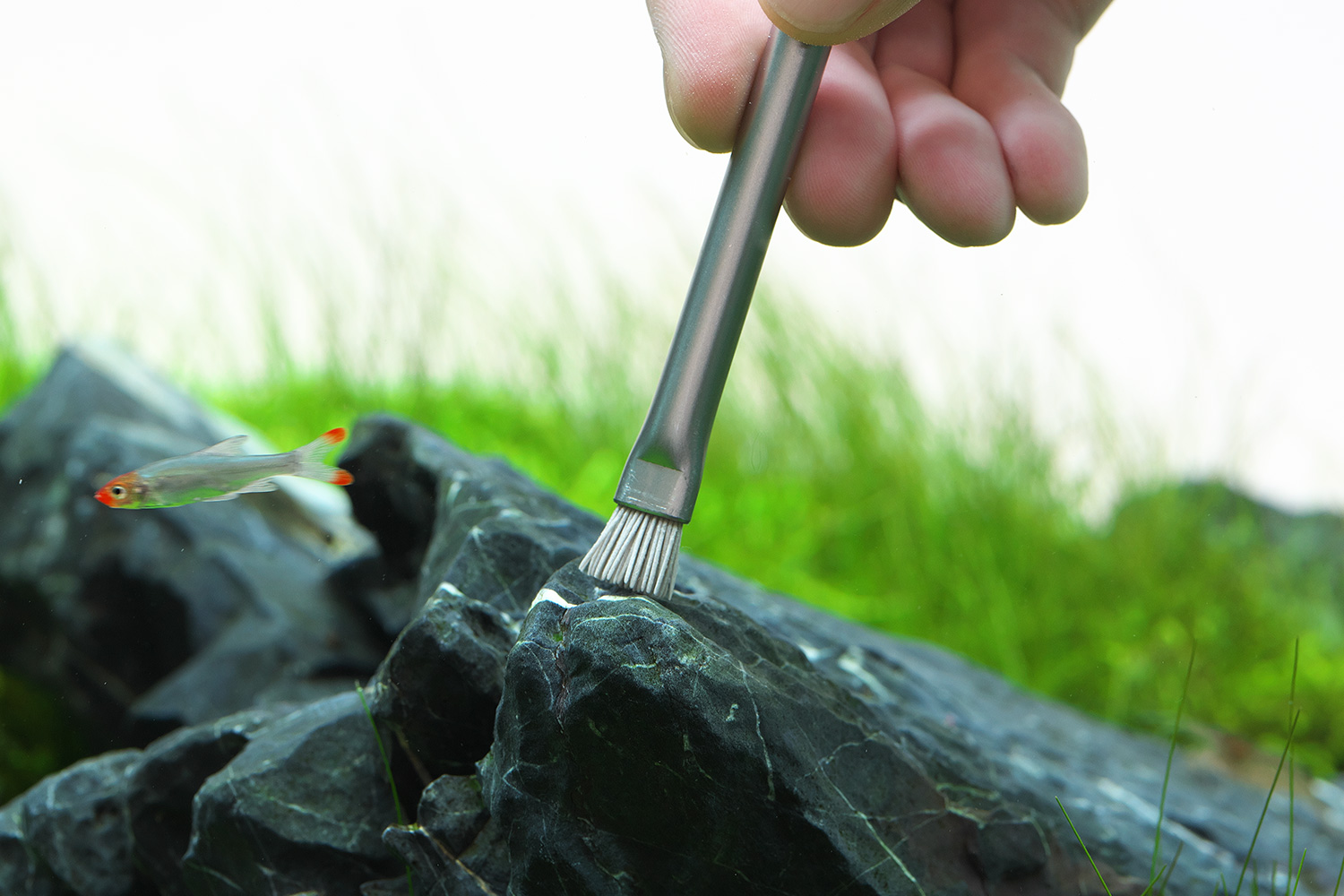
Restore the luster of Ryuho Stones
To bring back the bluish-white brilliance of Ryuho Stones, it’s essential to gently scrub away any algae that have adhered to them. The Pro Brush, which contains fine polishing compounds, removes algae thoroughly without damaging the stone. With each stroke, the stone’s texture becomes clearer and its brilliance returns, brightening the entire aquascape.
To bring back the bluish-white brilliance of Ryuho Stones, it’s essential to gently scrub away any algae that have adhered to them. The Pro Brush, which contains fine polishing compounds, removes algae thoroughly without damaging the stone. With each stroke, the stone’s texture becomes clearer and its brilliance returns, brightening the entire aquascape.
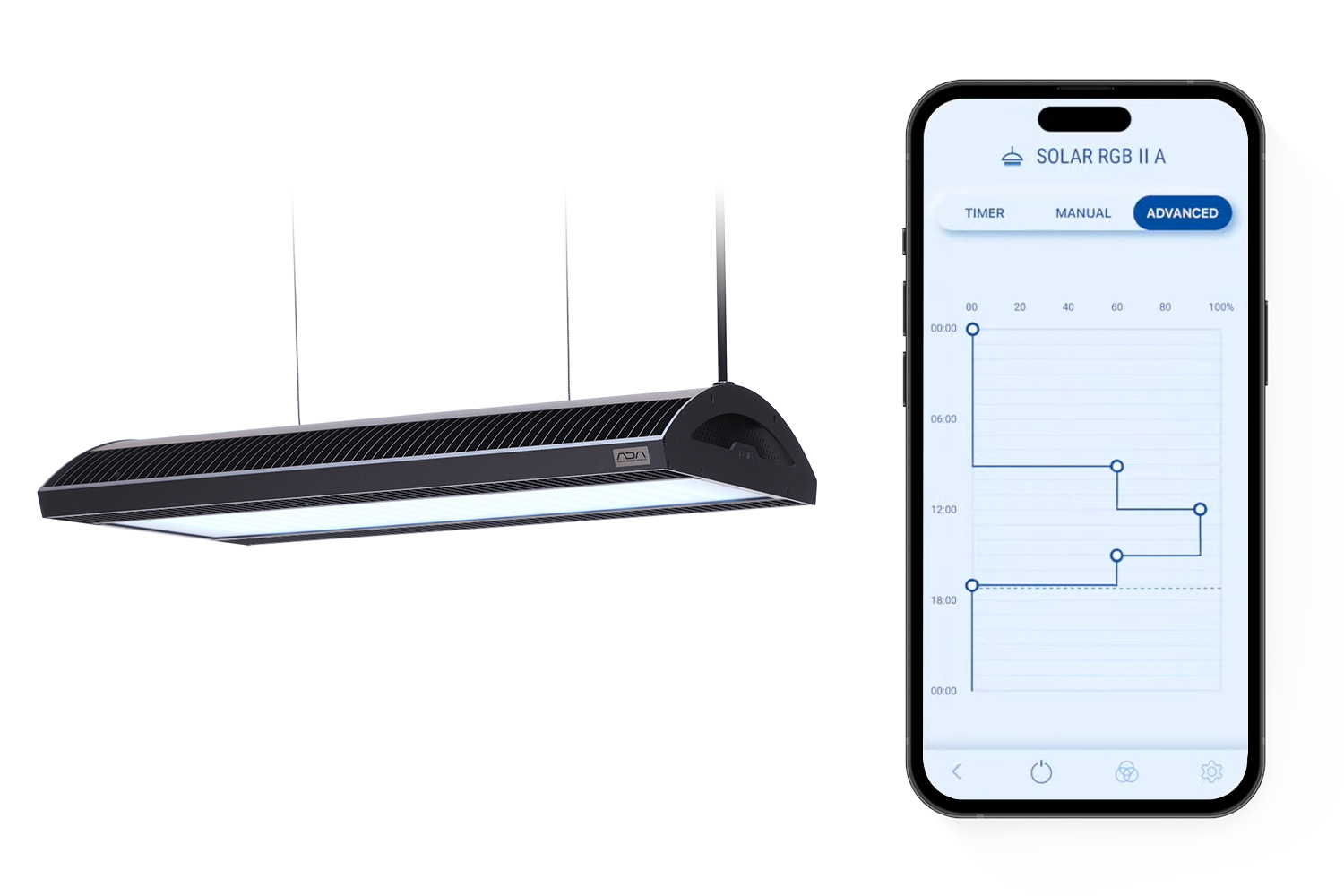
Use light to draw out the colors of aquatic plants
The plants used among the stones require high-intensity lighting, so the Solar RGB II’s advanced mode was used to adjust brightness throughout the day. Especially during the three hours after noon—when photosynthesis peaks—the light intensity was increased to 90% to replicate natural midday sunlight.
As a result, Rotala mexicana ‘Goias’developed a vivid red tone, adding rich color to the scene alongside the lush foreground plants.
The plants used among the stones require high-intensity lighting, so the Solar RGB II’s advanced mode was used to adjust brightness throughout the day. Especially during the three hours after noon—when photosynthesis peaks—the light intensity was increased to 90% to replicate natural midday sunlight.
As a result, Rotala mexicana ‘Goias’developed a vivid red tone, adding rich color to the scene alongside the lush foreground plants.
![Green Lab. #05 [Jewels of the Forest Floor]](https://www.adana.co.jp/wp-content/uploads/sites/3/2025/10/gl05_img_ogp.jpg)